Previous

|
Previous
|
Table of Contents |
Next |
Over the past decade the courts have handed down guilty verdicts in at least 5,000 cases involving personal injury or wrongful death in which the negligent party was found liable for at least $1 million in damages. More than 95 percent of these cases were settled before they ever went to trial although the settlement is still enforceable by the court. Most such cases were settled on a lump-sum basis.
Quite frequently the courts are seeking lifetime financial support for the injured party or throughout the minority of dependent heirs. Consequently it is usually acceptable to the court to have the liability paid in the form of periodic payments instead of as a single lump-sum payment. Insurance companies can and do issue immediate annuity contracts that will guarantee the payments over the required lifetime or over the mandated support period. These contracts are specifically tailored to the needs of the injured or wronged parties (claimants).
While the concept of paying periodic payments over time for claimant damages can be traced to the 1950s, independent full-time structured settlement specialists were not common until the 1970s. Since then the number of cases using structured settlement contracts to satisfy the plaintiffs� claims has grown substantially. The most frequent cases in which a structured settlement may be appropriate usually involve general liability, medical malpractice, defective products, automobile accidents, or worker�s compensation injuries.
Personal injury claim adjusters and/or defense attorneys work together with a structured settlement specialist to form a defense team. Their goal is to arrange settlements that will be appropriate and help to offset any damages suffered by the claimant, consistent with the issues of liability and the claimant�s future needs (both known and unanticipated).
Suitable structured settlements will provide an adequate amount of immediate cash for liquidity needs, reimbursement for past expenses, legal fees, and other cash needs. If the recipient is unable to work, an income stream can be designed to fund normal living expenses, custodial and medical services, rehabilitation costs, and where appropriate, tuition for educational programs.
Annuities Utilized in Structured Settlements
The usual structured settlement provides for annuities to pay out periodic payments that meet the recipient�s financial needs as much as possible. One of the primary advantages of structured settlements is that the periodic payments of income are received tax free by the claimant during his or her life and by the claimant�s beneficiaries thereafter for the balance of any guarantee period. Two of the requirements for the claimant�s income-tax-free treatment are the absence of any evidence of ownership by the annuitant of the annuities funding the structured settlement and the absence of constructive receipt or economic benefit in the annuity itself. Therefore all timing decisions, as well as the exact amount of money, are predetermined by the defendant or its insurer, who are the legal owners of the annuity.
If the claimant has no reduction in life expectancy from the injuries that caused the claim, standard rates are applied on life annuities. Likewise, if there is no life contingency, standard rates are used for fixed-period annuities. (An example of a fixed-period annuity is payments of $1,000 a month for 5 years and $2,000 a month during years 6 through 10. This is also referred to as a step-rate annuity.) Annuity benefit payments can generally be increased on a compound annual rate, ranging from 3 percent to 6 percent. In addition to life income guarantees, period-certain and joint-life guarantees can be used, depending on the circumstances involved.
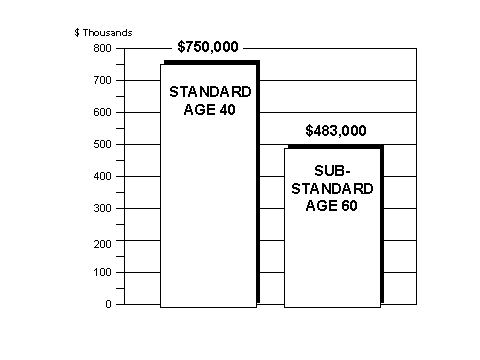
One of the most significant innovations that benefits both the claimant and the defendant is the rated age, or substandard life annuity (see figure 6-1). In a catastrophic injury case, the structured settlement broker submits the medical data to different insurance companies for evaluation. Each company makes its own judgment as to the claimant�s life expectancy and bases its annuity quotes on that opinion. Because this is largely subjective, life expectancy estimates vary from one company to another, just as rated-up life insurance varies from one life insurance company to another. Then the broker presents the bids to the defendant and his or her legal counsel to make an informed selection. The life insurance company underwrites the proposed annuitant�s current condition, including any preexisting health impairments.
The cost of a substandard annuity bears an inverse relationship to the cost of substandard life insurance. The lower the life expectancy, the lower the annuity cost and the higher the life insurance cost. A difference of 20 years in life expectancy could result in a 50 percent cost differential. Generally, this kind of annuity may be purchased only by defendants or their insurers in personal injury and wrongful death cases, and the number of insurers issuing such contracts is rather small. The claimant or plaintiff needs to cooperate in good-faith bargaining to achieve a fair settlement.
The substandard annuity provides the defense team with an extremely valuable financial vehicle. Less than one percent of the life insurance companies offer this discounted underwriting specialty.
|
FIGURE 6-1 |
|
|
Advantages of Structured Settlements
The advantages of a structured settlement for each of the individual entities involved are explained below.
For the Injured Party
Financial Security. The major advantage of a structured settlement for the injured party is financial security. A lifetime income is especially practical and desirable when a minor or someone acknowledged to be incompetent is involved. The approach is attractive, particularly to the court, whenever there is reason to be concerned about protecting the injured party�s future finances. In cases of wrongful death, a structured settlement may be used to provide replacement earnings to the claimant�s spouse and children.
Benefits that Match Needs. An injured party needs regular income to meet living expenses and medical care costs. On occasion, when future medical costs are estimated to be substantial but the timing of these costs is unknown, a medical trust, similar to an emergency fund recommended by financial planners, can be used. Typically, the medical trust is created with the defendant as grantor under a trust agreement that is part of the settlement agreement.
Management of Benefits. Claimants and their families or guardians are usually not trained to manage large sums of money. Dissipation of funds through mismanagement, imprudent investment, unwise expenditures, misuse, or even neglect is a high risk. This risk is significantly reduced through the use of periodic payments in a structured settlement.
Guaranteed Payment. Because the income payments are guaranteed for life or for a fixed period, the settlement can never be prematurely exhausted. There could be some reduction and delay in getting benefits if the insurer issuing the settlement agreement fails. Executive Life Insurance Co. is an example where the state guarantee funds are paying reduced benefits after a delay.
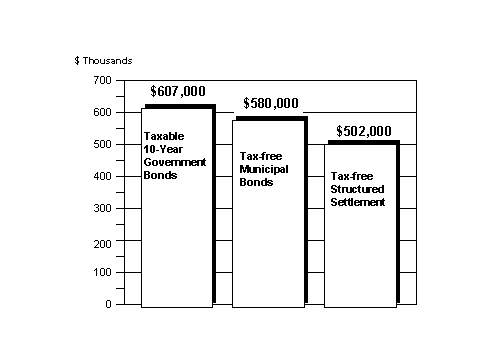
Income-Tax-Free Payments. Whether payments are in a lump sum or periodic, they represent personal injury damages, which are excluded from income tax under IRC Sec. 104(a)(2). (See figure 6-2.) (Further clarification of the tax-free nature of structured settlements is given in Rev. Ruls. 79-220, 79-313, and 77�230.)
The Periodic Payments Settlement Act of 1982 codified the above revenue rulings and clarified that the interest as well as the principal portion of periodic payments is income tax free. This same act not only amended IRC Sec. 104(a)(2) but also created IRC Sec. 130, which allowed for continuation of the tax-free treatment of qualified assignments. A qualified assignment allows the defendant or his or her insurer to assign the obligation to make the future payments to a third-party assignee. Usually, the assignee is an affiliate of the life insurance company providing the annuity payments and as assignee assumes the ultimate obligation from the defendant as assignor to make future payments guaranteed under the settlement agreement. The assignee typically is the parent
of the life insurance company providing the annuity, an affiliate life insurance company, or an affiliate shell company incorporated to hold the assignments. With the assignment, the defendant or the insurer receives an absolute release and closes the file. The annuity is purchased by the assignee, and the claimant or plaintiff is perceived to receive an enhancement of security (even though it is the status of a general creditor) because life insurance companies and their affiliates are regarded as being more stable than property and casualty companies in terms of solvency.
|
FIGURE 6-2 |
|
|
|
According to data from the Economic Report of the President, 1992, the 25-year average yield (1967�1990) of 10-year government bonds is 8.27 percent. This rate is assumed to apply to the settlement annuity tax-free and to the government bond fund. The income tax rate used on the government bond fund is 28 percent. The long-term Standard & Poor�s municipal bonds averaged a yield of 7.02 percent over the period 1967�1990; this rate was used to calculate the municipal bond fund above. If the actual investment returns in future years are lower than these past yields the amount of capital needed will increase. |
For the Plaintiff Attorney
Attorneys are assured that their client�s settlement is guaranteed and will not be subject to dissipation as is a lump-sum settlement. Some attorneys even believe that recommending a structured settlement insulates them from exposure to legal malpractice since they are not taking a sizable portion of the total value of the entire benefit payable as a lump sum right in the beginning.
For the Judge
Lump-sum settlements have an obvious disadvantage. The judge or jury must determine how much money the plaintiff will need for the rest of his or her life. If the plaintiff lives longer than expected, the lump sum is exhausted; if the plaintiff dies sooner than expected, his or her heirs could receive a windfall unintended in the settlement. Guaranteed periodic payments for life, however, assure the plaintiff of financial security regardless of when he or she dies and are therefore easier for a judge or jury to award.
For the Public
The public benefits from the structured settlement because the injured party will not become a ward of the state and will be assured of a guaranteed income and proper care. In addition, the delay of prolonged litigation is avoided, thereby reducing court costs and placing more burden on the already overloaded judicial system.
Disadvantages of Structured Settlements
If a life insurance company becomes insolvent, the insured may have to absorb all of the losses in excess of any Guarantor Association limitations. However, with the proviso that the insured is still insurable, he or she may replace life insurance coverage with another viable carrier. In the case of structured settlements, however, the income reduction from choosing a minimum benefit guarantee is not easily replaced. There may be insufficient funds from the insured�s other assets to offset the benefit reduction.
Besides the structured settlement specialist�s due diligence, the availability of a qualified assignment and compliance with the Uniform Periodic Payment of Judgments Act will mitigate any financial risks arising from a life insurer�s insolvency. For obvious reasons, therefore, structured settlement specialists should select only the most secure and well-managed insurance companies.
Because there is no right to accelerate or decelerate future payments, problems can occur if more immediate cash is needed than the stream of payments will provide. This may be due to an unprecedented financial reversal, a medical necessity, an educational need, or inflation over and above expectations. The unfortunate fact is that the periodic payment schedule may not be changed. The original design of the structured settlement should therefore anticipate increasing payments annually, or at least periodically, building in periodic deferred lump sums, or including a medical trust for future medical and custodial needs. In addition to providing an adequate amount of immediate cash for the benefit of the injured party, a well-designed structured settlement will carefully consider the needs of the claimant�s dependents.
Sample Structured Settlement Case
The following illustration involves a claimant, John Doe, aged 40, who is totally and permanently disabled due to an accident and will require substantial future medical and custodial care. In addition, his 3-year-old child, Annemarie, will require college funds since John Doe is no longer able to provide any income to save for this goal. As 50 percent of the total settlement, up-front cash of $1.125 million should be sufficient to pay the plaintiff attorney�s legal fees and to establish an emergency fund for John Doe. In addition, the income from a medical trust and a $1,000-a-month annuity should be adequate, according to the interpretation of the life care plan that was used as a guide to ascertain John Doe�s capital needs for the future. Independent living income of $30,000 a year, increasing at 3 percent compounded interest annually, should provide enough funds to maintain the Doe family�s routine cost of living and to help offset future inflation.
The average costs for room, board, and tuition at public and private universities were used to ascertain college fund requirements for Annemarie. These costs were then projected at the average inflation rate. Because many students take 5 years to complete their undergraduate college education, payments are forecast for a 5-year period. The proposed structured settlement is presented in figure 6-3.
Structured Settlement Services
Prior to designing a structured settlement proposal tailored specifically to the claimant, the structured settlement specialist receives the pertinent data from the claims adjuster and/or the defense attorney. The more data available for this purpose, the more appropriate the design is to the injured party�s needs. The structured settlement specialist then provides proposals and present-value estimates of streams of income to the defense team, adopting the design to
incorporate any variables they suggest. After a verbal settlement is reached, the structured settlement specialist usually provides the defense attorney with sample closing documents for reviews, such as a settlement agreement and release, a qualified assignment, and a medical trust agreement.
Very often the party purchasing a structured settlement is a property/casualty insurer providing liability coverage to the defendant. Structured settlement specialists devote a fair amount of effort and resources to informing possible purchasers of the potential savings available.
Profile of a Structured Settlement Specialist
Many structured settlement specialists have been claims representatives or claims adjusters. This is good experience for becoming a structured settlement specialist because so many aspects of structured settlements involve the resolution of familiar with the claims process and personal injury law.
|
FIGURE 6-3 |
||||
|
Claimant: John Doe |
Age: 40 |
Life Expectancy: 35 Years |
||
|
Guaranteed |
Estimated |
Cost |
||
|
Immediate Cash, Including Legal Fees Medical Trust Fund Annuity Seed (Payments of $1,000 monthly, compounding at 4% each year, starting in one month and continuing for the claimant�s life, with the first 20 years guaranteed) Independent Living Income (Payments of $2,500 monthly, compounding at 3% each year, starting in one month and continuing for the claimant�s life with the first 20 years guaranteed) College Funds for Daughter, Aged 3 Payment at age 18 Payment at age 19 Payment at age 20 Payment at age 21 Payment at age 22 |
$ 1,125,000 200,000 357,337 806,111 25,000 38,000 41,000 44,000 47,000 |
$ 1,125,000 200,000 883,827 1,813,862 25,000 38,000 41,000 44,000 47,000 |
$1,125,000 200,000 263,677 583,707 15,094 15,467 15,623 15,818 15,940 |
|
|
Totals |
$ 2,683,448 |
$ 4,217,689 |
$2,250,326 | |
The structured settlement company generally has a limited general agency relationship with approximately 12 life insurance companies who provide over 80 percent of the structured settlement annuities. Those 12 life insurers typically require a minimum production of structured settlement contracts each year from a specialist in order to continue representing the insurer and selling their contracts. They are highly selective about the companies to which they extend the general agency, probably because of the highly technical nature of the business. None of the companies that have major life insurance sales forces allow their regular life and annuity field sales force to participate in structured settlements. Generally, these same life companies do not allow structured settlement companies to sell their regular life and annuity products.
National Structured Settlement Trade Association
The National Structured Settlement Trade Association was created in 1986, primarily by independent structured settlement broker companies. Its goals are to advance the expansion of structured settlement concepts, promote favorable legislation and regulations, provide continuing education, develop guidelines for operational procedures, and establish a code of ethics for its members.
The year 1994 marks the first conferment of the association�s certified structured settlement specialists. They completed studies in the following categories:
Uniform Periodic Payment of Judgments Act/(Sec. 18)
To promote the widespread use of structured settlements, the Uniform Periodic Payment of Judgments Act was approved in 1990 by the National Conference of Commissioners of Uniform State Laws. Sec. 18 of that act limits the number of life insurance companies that may qualify as structured settlement annuity providers as follows:
(1) request the designation
(2) be an admitted insurer
(3) have a minimum of $100 million of capital and surplus, exclusive of any mandatory security valuation reserve
(4) have one of the following ratings from two or more of the following rating organizations:
� A.M. Best Company (A+, A+g, A+p, A+r, or A+s)
� Moody�s Investors Service Claims Paying Rating (Aa3, Aa2, Aa1, or Aaa)
� Standard & Poor�s Corporation Insurer Claims-Paying Ability Rating ( AA-, AA, AA+ or AAA)
� Duff & Phelps Credit Rating Company Insurance Company Claims Payable Ability Rating (AA-, AA, AA+ or AAA)
Even though many of the states have not adopted the Periodic Payment of Judgments statute, structured settlement specialists tend to use the most financially secure, highly rated life insurance companies (those most likely to be approved under the act should it later be adopted). Any changes in the rating system itself, such as A++ of A.M. Best, will be phased in by the states who adopt the Uniform Act.
Postsettlement Opportunities for Other Advisers
Life insurance and financial advisers can certainly provide additional services for recipients of lump-sum settlements as well as structured settlements. The injured party is usually represented by an attorney who specializes only in personal injury cases. Frequently, the attorney refers his or her client to the local bank but in most cases does not get involved in any planning after the settlement. Life insurance and financial advisers can provide valuable postsettlement services.
While planning is even more critical if the injured party receives all of the proceeds in a lump sum, financial planning services are still necessary for those who receive a structured settlement of some up-front cash and the balance in periodic income. Keep in mind that most large settlements involve an injured party who is no longer able to work. Therefore financial planning is crucial not only to preserve capital but also to ensure an adequate income currently and in the future. Can you imagine an injured person who has no education or training in finance or investments trying to do it alone? Can you imagine an employer giving a check for $500,000 to an employee with the following words, "This represents the present value of all your future benefits toward your long-term disability plan. Even though you are only 45 we hope that you will make the right decisions on current and future investments because this is the last check you�ll ever see from us."
Obviously, financial and estate planning are essential. In addition, the establishment of wills and trusts (and their periodic reevaluation) is also a vital service needed by accident victims whose income productivity has been impaired. Furthermore, with the creation of new insurance products (such as survivor life), a qualified life insurance adviser can help create the necessary liquidity for estate taxes and clearance costs for individuals who may be disabled but still insurable.
NOTES
|
Previous |
Top |
Next |